

Veyra Quill wasn’t running from anyone—she was a nomad traveler of worlds, one of those stubborn souls who treated star charts like suggestions and empty space like a library. The Axiom Runner suited her: lean, long-range, patched where time and bad luck had taken bites, with a matte-black ribbed strip along its spine the old mechanics called the chalkline—micro-thrusters and field emitters that flickered in tiny corrective bursts to keep long vectors honest. Her cockpit was cozy-chaotic: a swivel chair bolted to a half-rebuilt console, mismatched toggles from three different eras, and a nav display that occasionally offered emotional support like probably fine.
The trouble started as something almost insultingly small: a thin drifting cloud of micro-particles, too sparse to register until the Runner was already committed. Then the deflectors lit and began to saturate. Impacts stitched across the hull—ping-ping-ping turning into a steady hammering as relative velocity made dust hit like needles. The chalkline arced with blue sparks as particulate charge bled across the emitters. Veyra dumped power from the drive coils and tried to yaw out, but the control loop stuttered—corrections arriving late, then wrong—and the ship was already damaged, unstable, and falling toward the nearest planet like a thrown knife.
She woke to the tick…tick…tick of cooling metal and the smell of scorched insulation. The planet below was sterile in the way a factory floor is sterile—glassy black sand, hard angles on the horizon, no wind, no biological life. The Runner lay half-buried and torn open aft, but Veyra grabbed what mattered and limped away before anything local could notice a fresh impact signature. Her suit pinged the environment and snapped to its rules with a cold overlay: movement here was measured in quanta, the smallest unit—no meters, no smooth strides, just reality clicking forward one discrete step at a time. She kept the ship out of sight behind a low ridge of fused sand and walked on, because if anyone was going to get found first, it needed to be her, not the Runner.
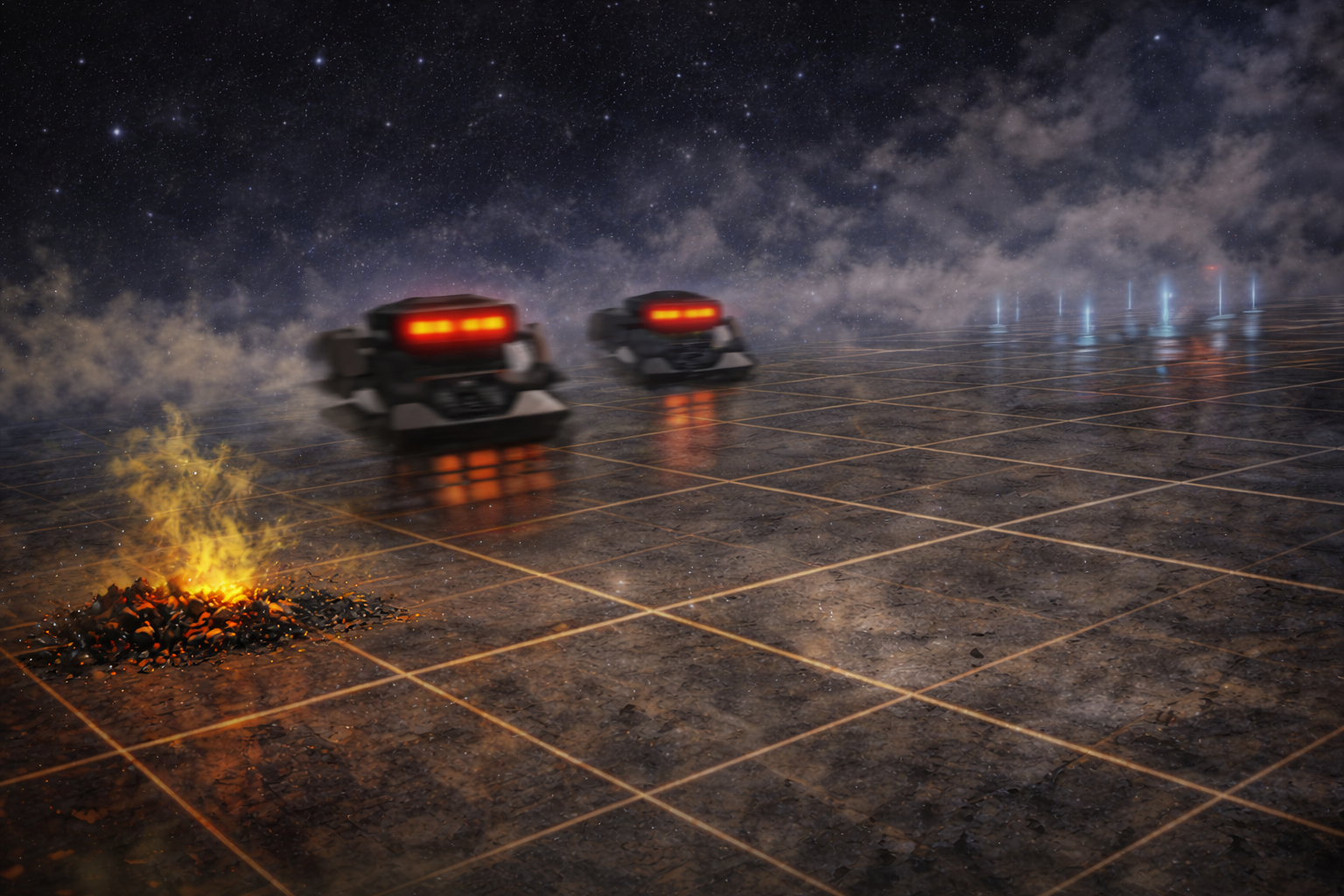
The locals arrived in formation and in contempt. Not humanoids—just machines: low, angular chassis that slid and clacked along the grid like pieces on a board, snapping to the same quanta rules she did. Their sensor arrays locked onto her position and ignored almost everything else, and their voices came out in brittle unison. “Halt, bioform!” one blared. Another added, delighted with itself, “Stop, meatbag!” They had no weapons, no blasters, just numbers and momentum—trying to herd her into a dead end and letting proximity do the killing.

Veyra had two tools and a rule: don’t waste miracles. The coin-sized short-range teleporter could hop her a handful of quanta, but every rapid use made it drift—tiny accuracy errors compounding until a “clean” blink could land her half a step wrong, and on this world half a step was a funeral. If she moved manually for a couple of quanta—boots on ground, honest motion—the device re-centered and regained accuracy, like it needed her to remind it what “here” meant. The sonic screwdriver was her other lever: within one quanta, it could disintegrate robots or deactivate electrowalls but it had tiny counter on its side winked in her palm with the number of uses. The handy device was able to charge up from a surrounding environment and this world provided plenty of charging potential.
She turned the chase into a physics lesson the machines couldn’t pass. Blink, step-step, blink—always resetting the teleporter, always making their pursuit lines intersect. The first collision was almost graceful: two units converging on her last known tile, both insisting they had right-of-way, both snapping into the same space with a hard metallic crack. Frames tangled, joints ground, and they toppled into a growing pile of wreckage—scrap housings, snapped linkages, twitching actuators, leaking chemistry from cracked power cells. The best part was the pile might as well have been invisible. Their sensors were so concentrated on her that anything not-her didn’t exist as a threat, so other units kept charging and joined the heap with the same offended determination.
She didn’t need miracles. She needed parts and time, and the planet looked like it had plenty of the first and very little of the second. Between surges she ducked behind the debris pile—careful to take two manual quanta first so her teleporter stayed honest—and did what nomads always do: she salvaged. The sonic screwdriver chirped tight pulses to pop latches and bully fasteners loose. From a crushed fluid module she extracted a coolant hose, braided and intact, rated for pressure she hoped the Runner wouldn’t exceed while it was angry. From a half-melted field assembly—still humming faintly, like a bee trapped in a jar—she freed a compact grav coil. From a shoulder-sized actuator housing she yanked a servo motor, gear teeth scuffed but functional, and from a cracked switching block she salvaged a chunky power relay with clean contacts.
That was the easy part. The power regulator took hunting: she had to follow a conduit trench to a maintenance bay where wreckage had accumulated into a denser “self-made warehouse,” and she found a regulator board wedged under three fused chassis plates like it was being punished. The inverter was worse. It was there—she could see the signature on her suit scan—buried deeper in the pile where units had compacted into a tight tangle, and she had to kneel, reach in, and pry carefully while the synchronized clatter of pursuing machines grew louder behind her.
That was when “almost trapped” stopped being a figure of speech.
A cluster of machines snapped around the pile, boxing her in by accident—too many of them converging at once, too tight a lane, too little space for her to slip out without brushing their metal. One slid into the gap so close she could see its sensor strip pulsing like an irritated heartbeat. “You’ll tire soon, faulty-meat!” it barked. Veyra didn’t blink—teleporter drift plus tight quarters was how you telefrag yourself into a bad obituary—so she did the dangerous thing instead: she lifted the sonic screwdriver, aimed within a single quanta, and fired. The unit dissolved into a hard spray of shimmering grit. The counter on the tool ticked down, hope I do not need that again too soon she thought to herself. The sudden absence created just enough space for Veyra to step-step out, resetting her teleporter with two honest quanta while the machines behind her continued forward, unaware they’d just lost a friend to chemistry and hubris.
A second time, the trap was geometry. An electrowall snapped up across the corridor crackling, vertical, lethal to her and meaningless to them—cutting off the clean escape lane she’d been steering toward. Behind her, units converged, snapping faster, their insult-file getting excited. “Nice sprint, floppy mammal,” one jeered from the crowd. Veyra counted quanta in her head, felt the teleporter’s itch for another blink, and rejected it. She leaned into the electrowall instead—close enough to taste ozone—and hit it with the sonic screwdriver. The energy sheet shuddered, then fell as if someone had ripped a curtain down. Behind her, the machines streamed through the fading field without even noticing it had existed, then immediately piled into each other at the choke point she’d just created, expanding the wreck heap with fresh enthusiasm.
Later, she found the inverter at last—half-buried, exactly where her scan had insisted it was—but a robot had snapped into the lane between her and the part. It wasn’t guarding it intelligently; it was simply there, occupying the tile like an idiot chess piece that believed it was a king. Veyra needed that inverter more than she needed to conserve politeness. She stepped one quanta closer, aimed, and disintegrated the unit with a short pulse that sounded like a cough in a cathedral. The lane cleared, and she reached in, pried the inverter free, and tucked it into her pack like a stolen heartbeat.
By the time the sterile sky began to lighten at the horizon, she had everything the Axiom Runner’s diagnostics demanded: coolant hose, grav coil, servo motor, power relay, power regulator, inverter—each scavenged from the machines’ own compulsive collisions, each earned one quanta at a time. The robots were still not smart, but they were persistent, and the electrowalls kept appearing in uglier patterns as if the planet itself was getting annoyed at her continued existence. Veyra stopped treating the sonic screwdriver like a magic wand and started treating it like ammunition; every time the counter winked at her, it felt like the universe tapping its watch.
She returned to the Runner on foot, deliberately, making sure she wasn’t leading a procession back to the hidden crash site. Inside the torn aft compartment, she worked by flickering emergency light and the kind of calm you can only fake if you do it often enough. The coolant hose seated into the manifold and the leak warnings eased. The grav coil locked into its housing beneath the vector core, and the ship’s field balance stopped feeling like a drunken compass. The servo motor went into the fin assembly, and the fin finally twitched in response instead of sulking. The power relay snapped into the switching rack; the power regulator stabilized the bus; the inverter brought the ship’s subsystems back into agreement with the concept of electricity.
When the Axiom Runner finally lifted free of the black sand, Veyra didn’t celebrate—she’d learned the universe charged interest on confidence. She climbed on a shaky vector, chalkline emitters flickering in tight corrective bursts, and watched the sterile grid-world recede below like a diagram someone forgot to label. The nav display blinked once, as if clearing its throat, and offered: probably fine. Veyra snorted, set a course to a friend’s planet—someone with a dry dock, spare parts, and discretion—and keyed in the coordinates with the quiet faith of a traveler who’d survived worse by refusing to stop moving. Then she leaned back, hands steady on the controls, and hoped for the best the way nomads always do: not because hope was reliable, but because it was light enough to carry.

Gameplay
Units
The game uses a quanta as the basic movement unit – one space on the grid. The playfield is a 23-wide by 22-tall grid, for a total of 506 possible spaces.

Moving and Eliminating Robots
The game starts with level one, on the 23 x 22 grid, with you (represented by a @) and 3 robots (represented by a R).
Your goal is to survive by tricking the robots into crashing into each other or into the toxic debris piles left behind by their comrades’ misfortune.
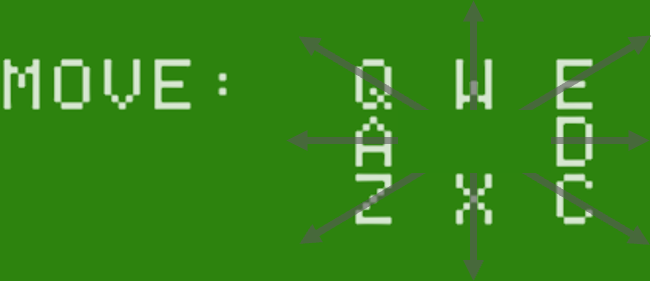
You move using the keys shown on the screen, allowing movement vertically, horizontally, or diagonally; the robots have the same movement options. You move first, then the robots move, and the cycle repeats. Try to stay several quanta ahead, then change direction so multiple robots attempt to occupy the same space. This results in their destruction.
Tools
When you find yourself trapped, robots all around you and you know the next move could be your last, use one of your two tools to help you get out of a jam.

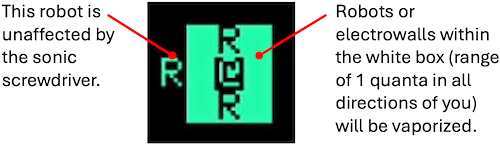
A sonic screwdriver, which you can use to disintegrate robots and deactivate electrowalls within 1 quanta (space) of the player. The sonic screwdriver has limited use. You gain one additional sonic screwdriver use per each level completed. The sonic screwdriver has a proximity circuit, and it will not fire unless a robot or electrowall are within one quanta range.
A teleporter, which will randomly teleport you safely to a different location on the grid. Watch out though, the teleporter loses accuracy with repeated sequential uses (shown in the status area on the right). Moving manually allows the teleporter to regain accuracy so you can teleport again safely.
Electrowalls
Electrowalls ("#") begin at level 6. These walls are erected by the robots to restrict your movements in hopes they can more easily capture you. Robots can pass through electrowalls unharmed, but it is game over if you run into one. Robots create electrowalls in increments matching the current level (for example, level 6 creates 6 electrowalls, and level 12 creates 12). Robots only have enough energy to create 75 electrowalls.
Scoring and Last Stand
You receive 10 points for each robot that you destroy. You can score 30 points per robot destroyed when you start a last stand. If you are sure you are safe and the robots will march in their predictable pattern to certain death, use the last stand. You forfeit your ability to move until either you miscalculated and a robot eliminates you, or all the robots march to certain demise and you advance to the next level.
For those interested in high scores, the best combination of score metrics is a high score with the lowest number of moves, and most levels completed.
Parts
There are six parts that you must collect and repair your ship, the Axiom Runner. You must collect a Coolant Hose, Gravitation Coil, Servo Motor, Power Relay, Power Regulator, and Power Inverter. Parts appear on the grid as a "%" (percent sign) and you collect a part by moving into the same grid space.
A message will appear when a part is within range. When you collect one, the game tells you which part you found and which part you should search for next. Try to grab the part without getting into robot trouble. If you eliminate all robots before collecting the part, you will have another chance on the next level.
When you have collected all the parts, you will have completed the repairs on your ship, and it will appear as a letter "S". Move to the same space as the ship and you will be able to escape the robot planet of Kharon Array and win the game!
As soon as you enter the same space as your ship, the game will pause momentarily and then present you with the winning animation sequence.
Scoring and Last Stand
You receive 10 points for each robot that you destroy. You can score 30 points per robot destroyed when you start a last stand. If you are sure you are safe and the robots will march in their predictable pattern to certain death, use the last stand. You forfeit your ability to move until either you miscalculated and a robot eliminates you, or all the robots march to certain demise and you advance to the next level.
For those interested in high scores, the best combination of score metrics is a high score with the lowest number of moves, and most levels completed.
Credits
Vector Pursuit for the Apple ][ was written by Greg Jewett (2026). The first public release was version 1.6.
The game Vector Pursuit is a highly modified derivative of the game called “Chase”[1] There have been other notable versions for other platforms called “Escape!”, “Zombies”, “Daleks” (on MacOS), and “Robots” (on Unix). The original author of the game remains unknown, but it is highly likely it started on the DTSS ("Dartmouth Time-Sharing System") system at Dartmouth College in the early 1970s. The first public versions appeared in the Creative Computing magazine in early 1976 and a variety of modified versions appeared over the next few years.
The program was compiled to run faster utilizing Beagle Bros AppleSoft BASIC Compiler[2], written in 1986 by Alan Bird. Beagle Bros’ AppleSoft Compiler was a classic Apple II productivity booster that took programs written in AppleSoft BASIC and translated them into machine-language executables for dramatically faster run time (often making games, simulations, and number-crunchy code feel “arcade snappy” instead of “BASIC patient”). It was designed to keep the AppleSoft workflow familiar—write and debug in BASIC, then compile for speed—while offering compiler-oriented features like linking/runtime support, options for handling strings and math efficiently, and tools to help you fit programs into memory and reduce overhead. In practice, it shined at accelerating tight loops, graphics routines, and repeated calculations, and it became part of the Beagle Bros tradition of making the Apple II feel like it had a secret “turbo” switch hidden under the hood.
Graphics and some coding were completed with the assistance of ChatGPT with carefully written prompts.