



Fire up the Apple ][ and get comfy: this 3-Pack is a mini arcade —three very different games with one shared mission: keep you saying “just one more round” until it’s suddenly later than it was a minute ago. Inside you’ll find Vector Pursuit, Marbles, and Maze Runner—action, puzzle, and exploration, all tuned for that crisp, pixelated, 8-bit kind of fun.

Marbles
Written by Daniel Henderson
Marbles is a deceptively simple “stack-and-clear” puzzle game with the classic recipe: easy to learn, hard to put down. Drop marbles into columns and build vertical groups of matching marbles to eliminate them before the board becomes a colorful disaster of your own making. It starts friendly… and then the game quietly turns the difficulty knob with a grin.
As you advance, the rules tighten: each level demands larger stacks before a column will clear, forcing smarter placement, tighter planning, and occasional acts of desperate brilliance. It’s part logic, part luck, part “I swear I had a plan,” and it nails that perfect Apple ][ puzzle rhythm.

Maze Runner
Coded by Resman
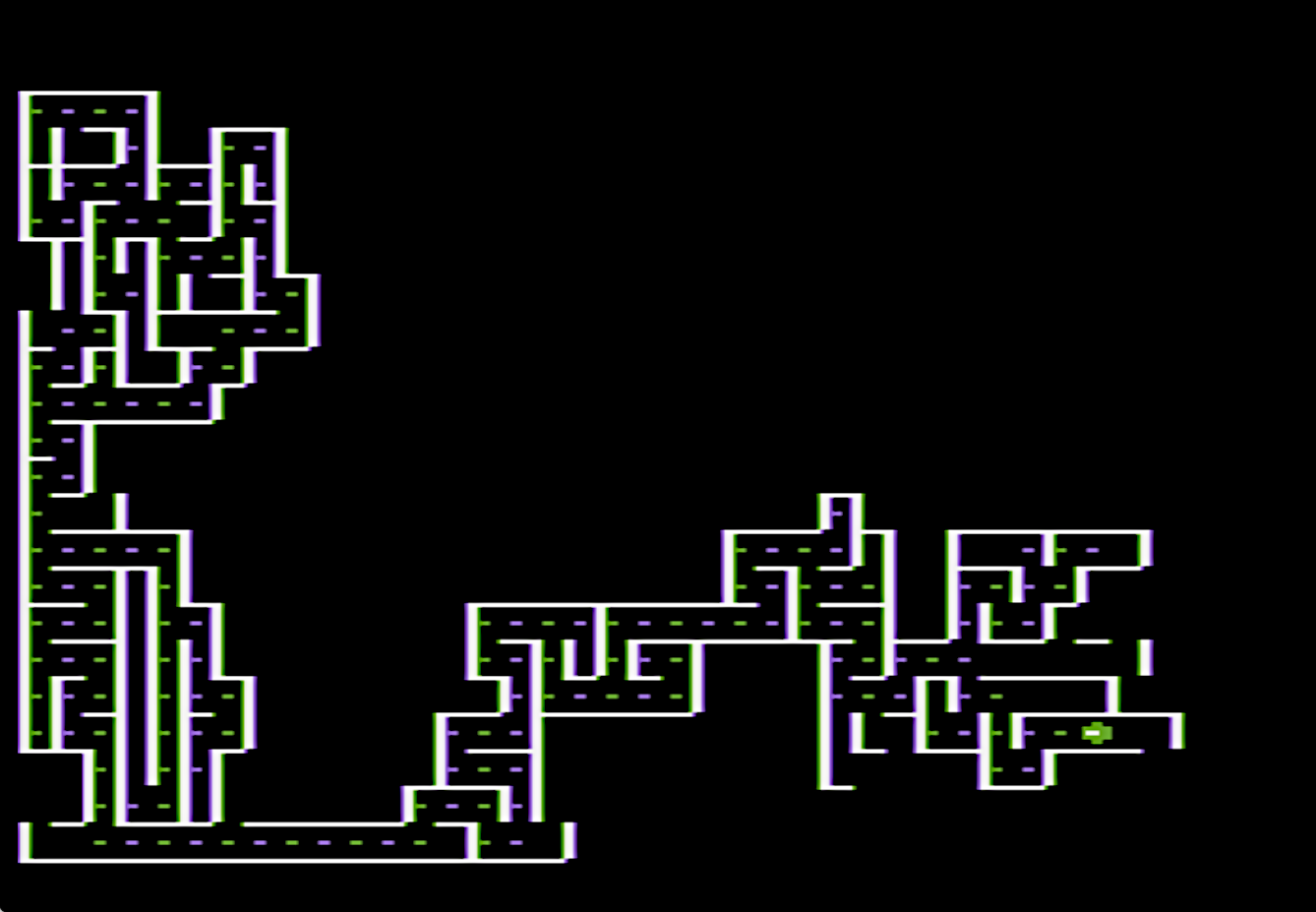
Maze Runner is a clean, classic maze challenge with a twist: you can’t see the whole maze. You only reveal corridors as you explore, so every run feels like pushing into the unknown with nothing but your wits (and a growing suspicion that the maze is laughing at you). When you smack a wall, the player lets out an “ouch”—because the maze demands humility.
The goal is to reach the finish in the fewest moves, golf-style: efficiency is your high score. And when you finally crack the route, the game celebrates with you—turning that last stretch into a tiny victory lap for your brain. Simple concept, surprisingly addictive, and perfect for “one maze before bed” (famous last words).

Vector Pursuit
Developed by Greg Jewett
You are Veyra Quill, stranded on the mechanical nightmare world of Robot Kharon Array after a crash landing. The only way off this metal marble is to collect the ship parts you need while avoiding the planet’s… enthusiastic robot population. Every move counts—because the robots are persistent, the arena is unforgiving, and the difference between “escape plan” and “scrap heap” is usually one risky step.
The vibe is tense and tactical: dart, lure, reposition, grab what you can, and survive long enough to rebuild. The stark vector-styled presentation and clean HUD make it feel like a sci-fi terminal come to life—like your Apple ][ is issuing you a calm, polite warning while everything tries to murder you.
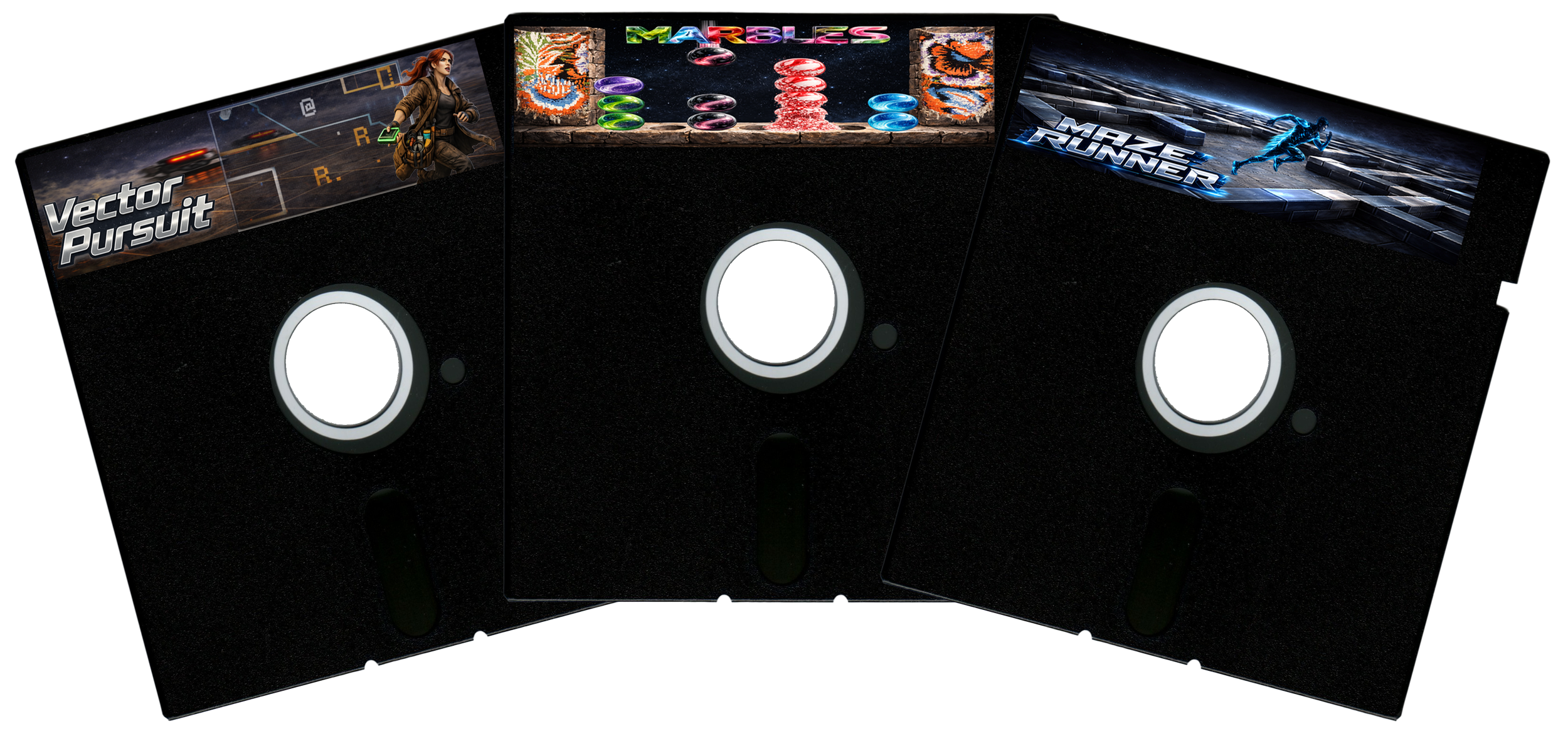

Our 3-Pack delivers the Apple ][ experience the way it was meant to be: three games on a bootable 5-1/4” diskette set, compatible with Apple ][+ and newer computers. This is a physical-only release at launch—no downloads, no installers—just the satisfying ritual of booting straight from disk and letting your machine do what it does best. It’s a throwback to that classic routine: walking into a store, spotting a new title, bringing it home like contraband treasure, and knowing your evening just got wonderfully unproductive.
In the package you’ll find beautifully labeled floppy disks and a tri-fold instruction pamphlet with clear, classic-style guidance you can keep right beside the keyboard. It’s designed to recreate that “new game day” feeling: flip open the pamphlet, load the disk, close the drive door, and jump in—then look up later and realize you’ve been playing for hours. Pure Apple ][ charm, in a form that feels real in your hands and instantly familiar on the screen.


Marbles: How to Play
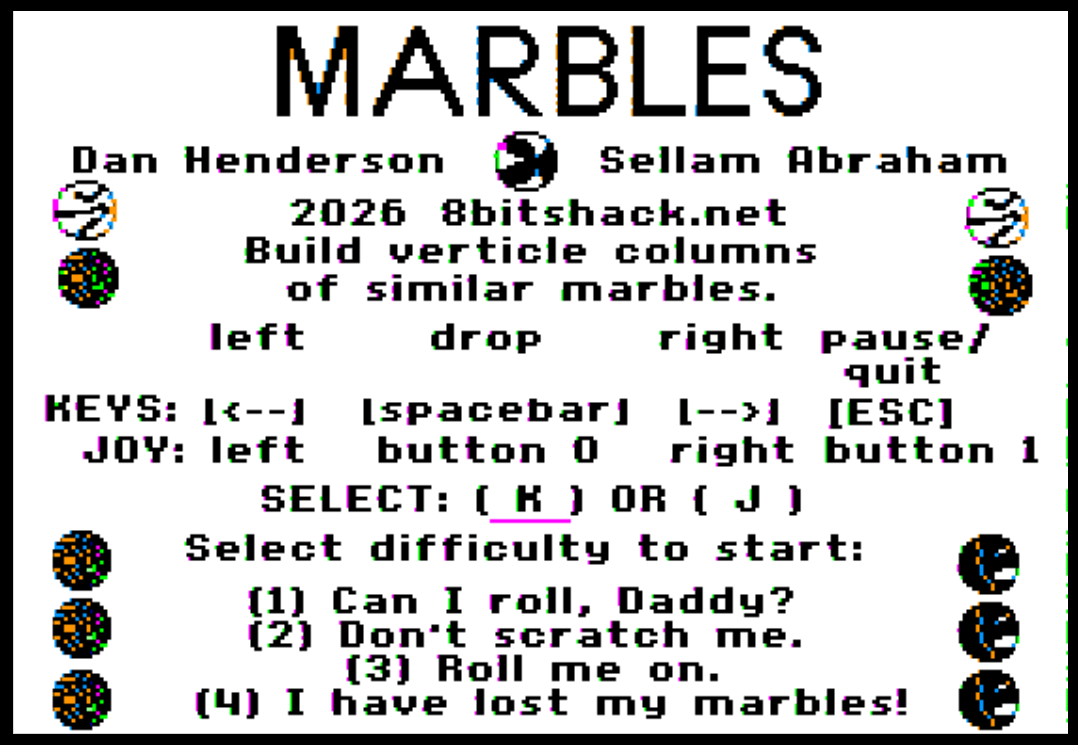
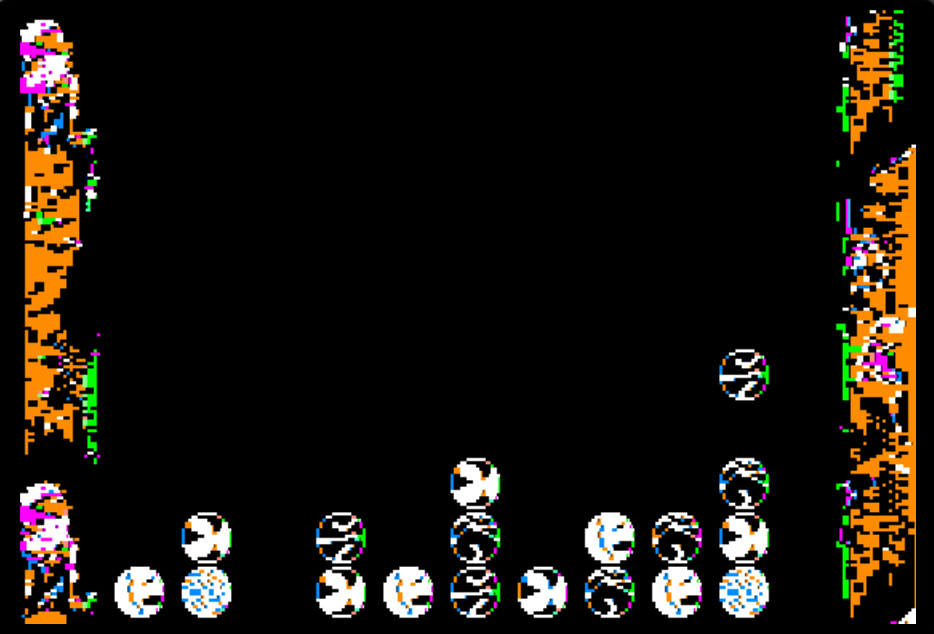
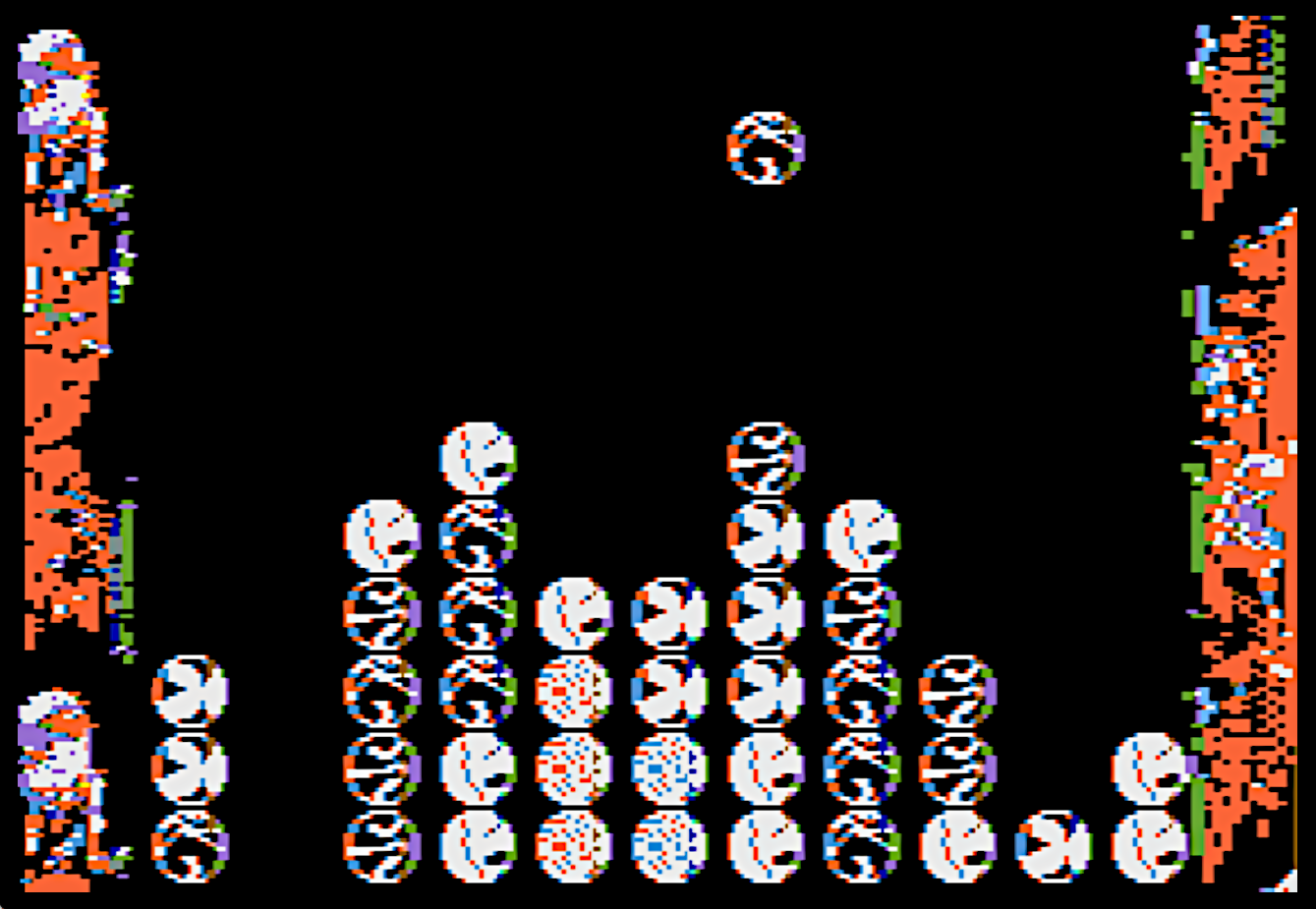
Marbles is a fast, addictive stacking-and-clearing puzzle game for the Apple ][, written by Daniel Henderson and Sellam Abraham. Your goal is simple: guide falling marbles into columns and build vertical stacks of matching marbles to clear them—before the pile reaches the top of the screen.
The Core Idea
Marbles fall from the top of the playfield and move until it reaches the bottom or is dropped. When you stack enough matching marbles in a single column, that stack clears. The twist is that the game gets tougher as you go. The game begins with a stack of two matching marbles clears, then three matching marbles, and so on. You’ll only know you’ve advanced when you hear a sound — your only clue that the rules just got stricter and you’d better plan ahead.
Levels and Difficulty
There are four starting levels, and each level changes the size of the enclosure (the playable space you have to work with). As the required match count increases, you’ll need smarter placement and better column management to avoid getting boxed in.
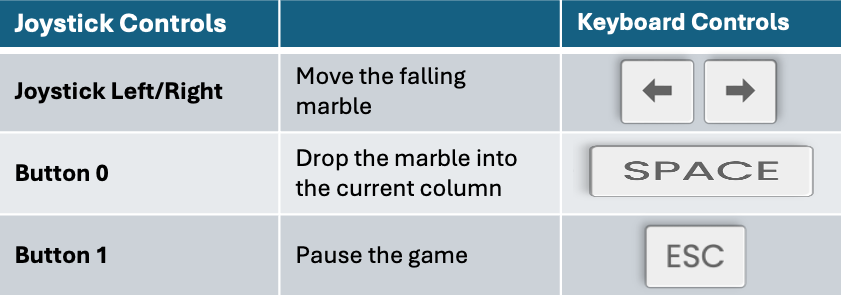
Choose your
control method:
Press:
K for Keyboard
or
J for Joystick
Game Over
You keep going until the marbles reach the top of the screen, block-stacking style. When the board fills up, it’s game over—time to regroup and take another run at it.

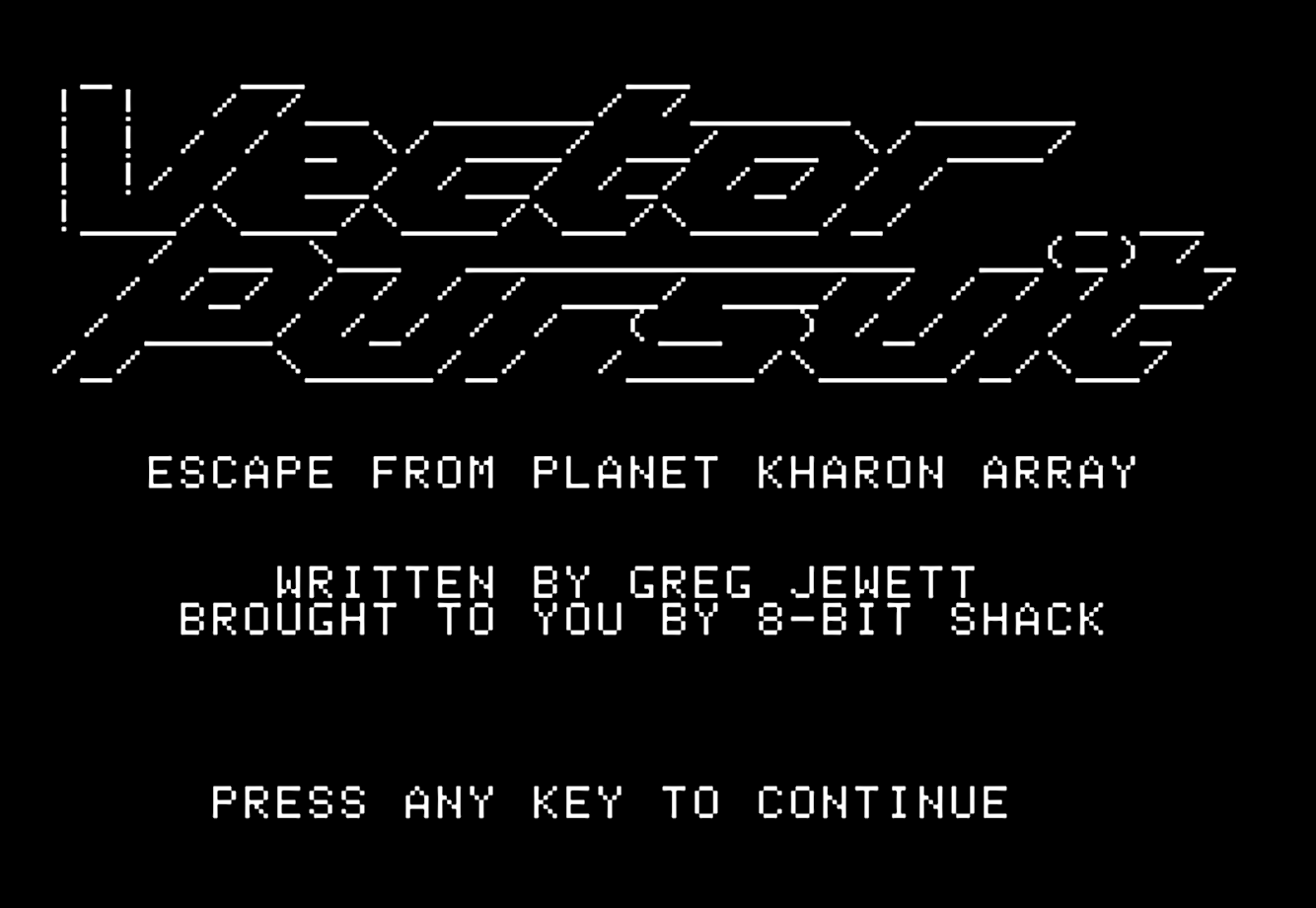
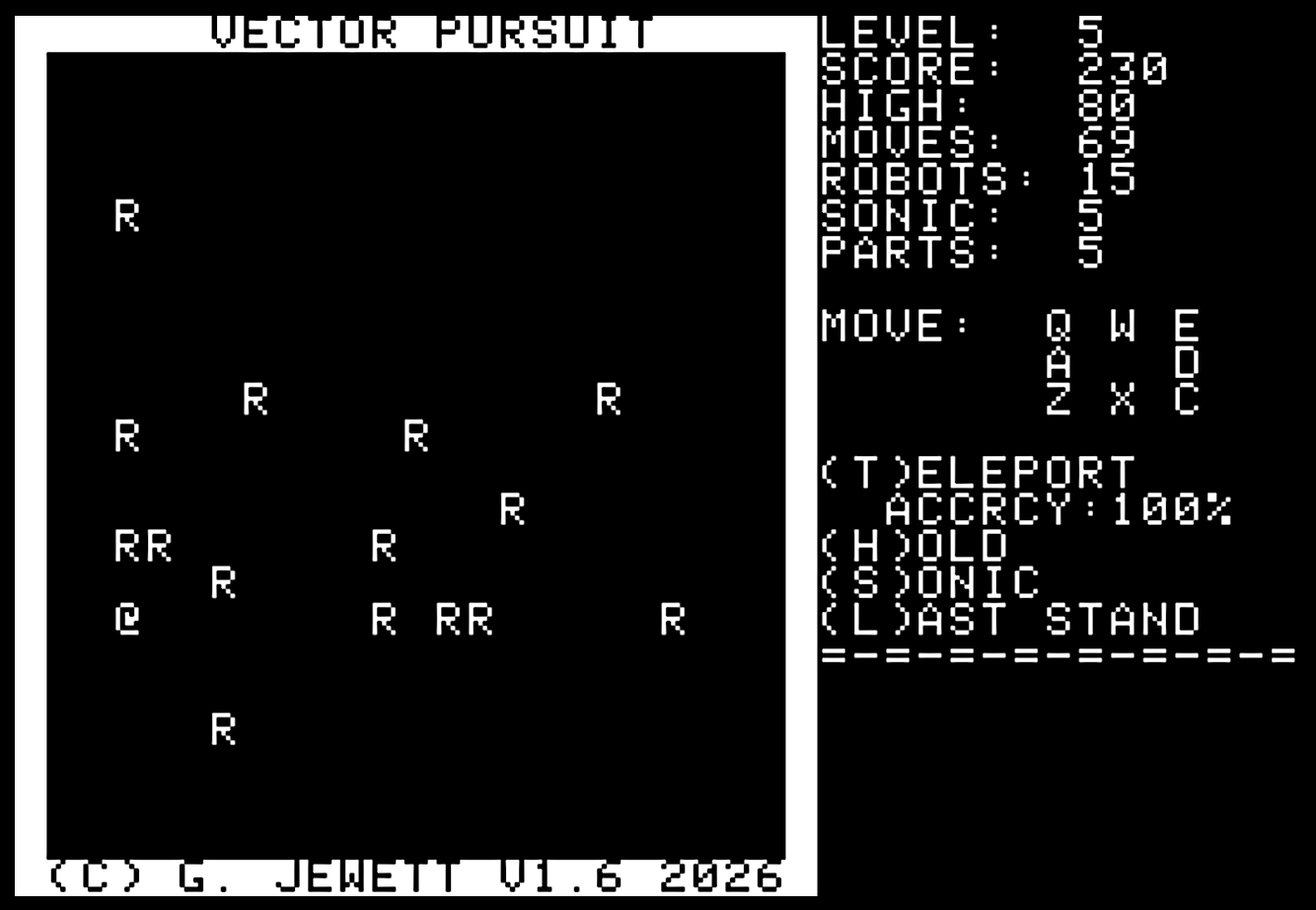
The game uses a quanta as the basic movement unit – one space on the grid. The playfield is a 23-wide by 22-tall grid, for a total of 506 possible spaces.
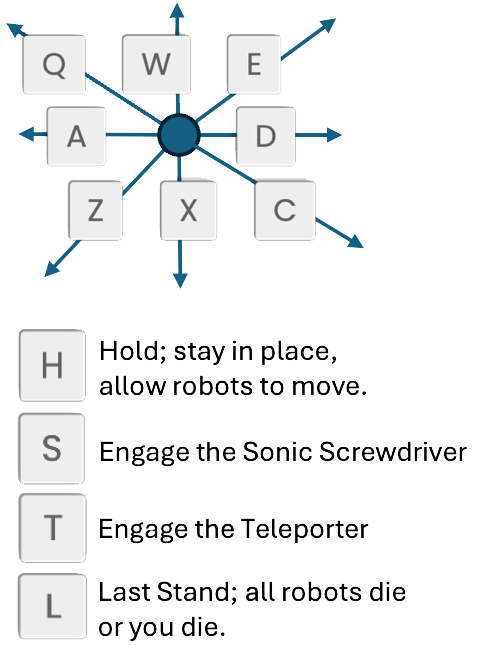
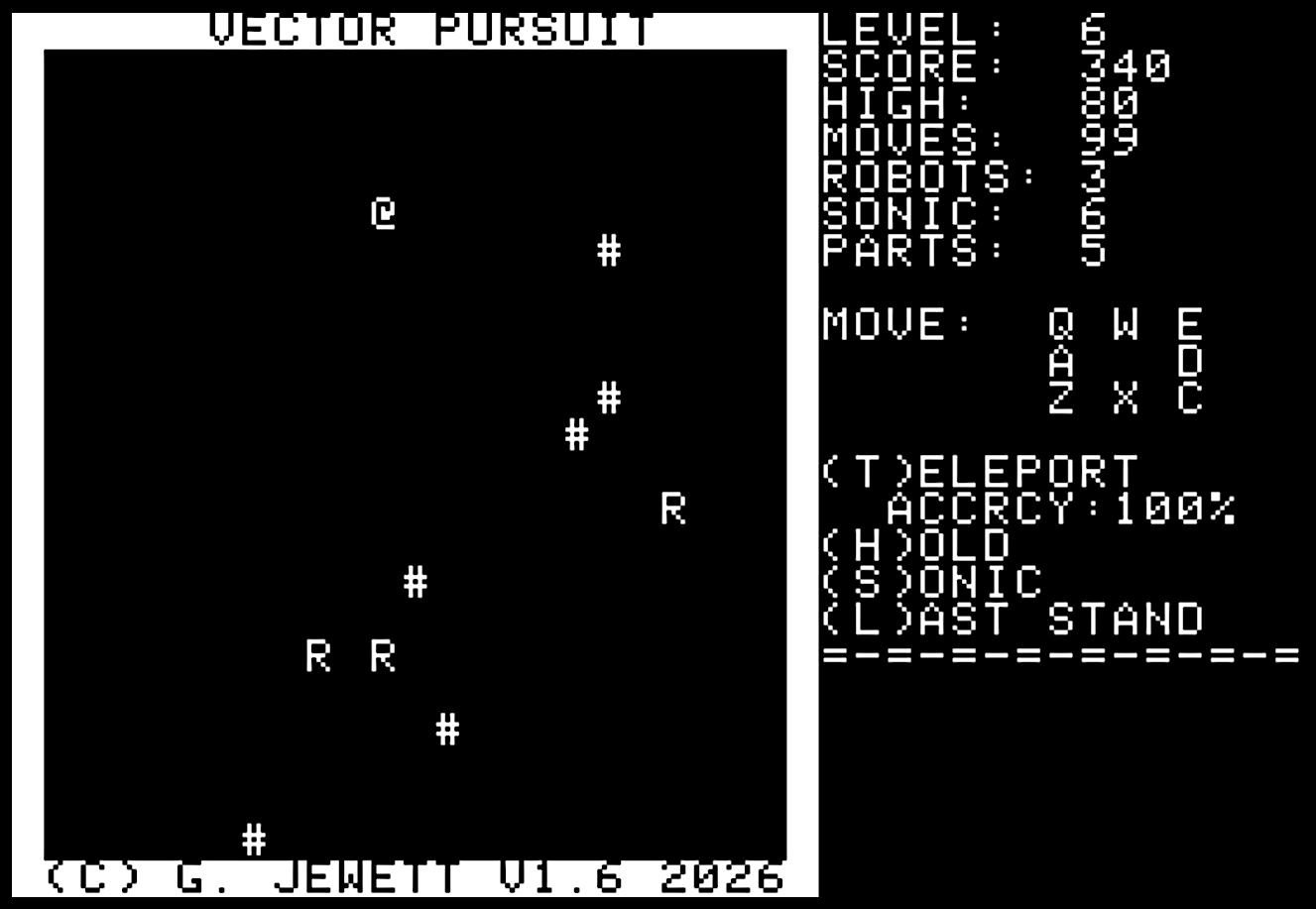
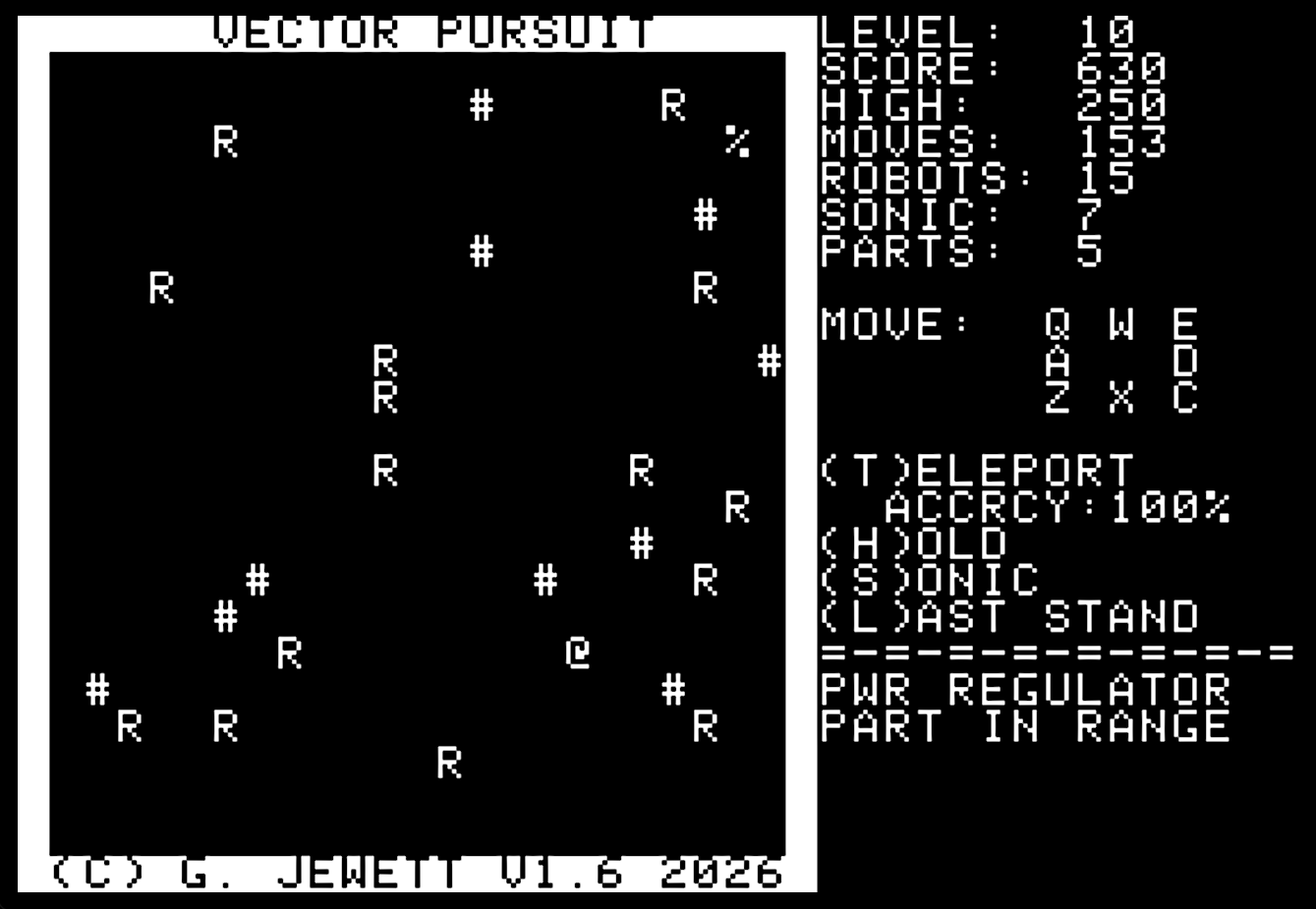
The game starts with level one, on the 23 x 22 grid, with you (represented by a @) and 3 robots (represented by a R). Your goal is to survive by tricking the robots into crashing into each other or into the toxic debris piles left behind by their comrades’ misfortune. You move using the keys shown below, allowing movement vertically, horizontally, or diagonally; the robots have the same movement. You move first, then the robots move, and the cycle repeats. Try to stay several quanta ahead, then change direction so multiple robots attempt to occupy the same space. This results in their destruction.
Tools
A teleporter, which will randomly teleport you safely to a different location on the grid. The teleporter loses accuracy with repeated sequential uses. Moving manually allows the teleporter to regain accuracy.
A sonic screwdriver, which you can use to disintegrate robots and deactivate electrowalls within 1 quanta (space) of the player. The sonic screwdriver has limited use. You gain one additional sonic screwdriver use per each level completed.
Electrowalls
Electrowalls ("#") begin at level 6. Robots can pass through electrowalls unharmed, but it is game over if you run into one.
Parts
There are six parts that you must collect and repair your ship, the Axiom Runner. You must collect a Coolant Hose, Gravitation Coil, Servo Motor, Power Relay, Power Regulator, and Power Inverter. Parts appear on the grid as a "%" (percent sign) and you collect a part by moving into the same grid space. When you have collected all the parts, your ship will appear as a letter "S". Move to the same space as the ship and you will be able to escape the robot planet of Kharon Array and win the game!
Scoring and Last Stand
You receive 10 points for each robot that you destroy. You can score 30 points per robot destroyed when you start a last stand. If you are sure you are safe and the robots will march in their predictable pattern to certain death, use the last stand. You forfeit your ability to move until either you miscalculated and a robot eliminates you, or all the robots march to certain demise and you advance to the next level.
For those interested in high scores, the best combination of score metrics is a high score with the lowest number of moves, and most levels completed.
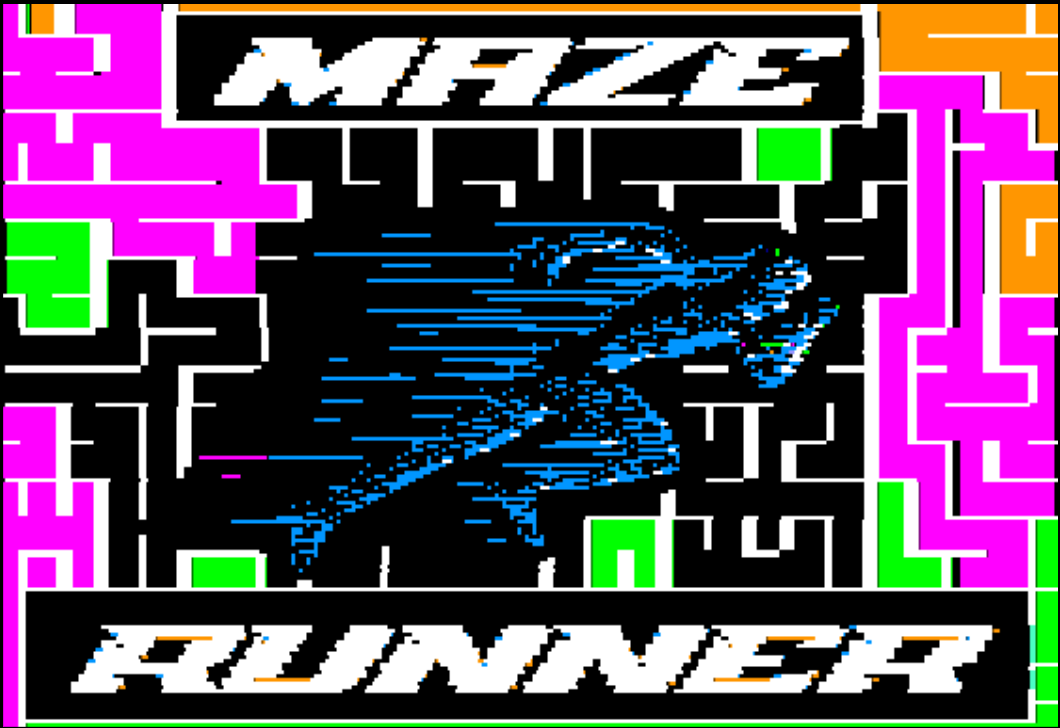
Maze Runner: How to Play
Maze Runner is a quick, classic maze challenge where exploration is half the battle. You start in a maze you can’t fully see—the paths reveal themselves only as you move, so every run feels like mapping the unknown one step at a time. Find your way from the start to the exit using as few moves as possible.
How the Maze Works
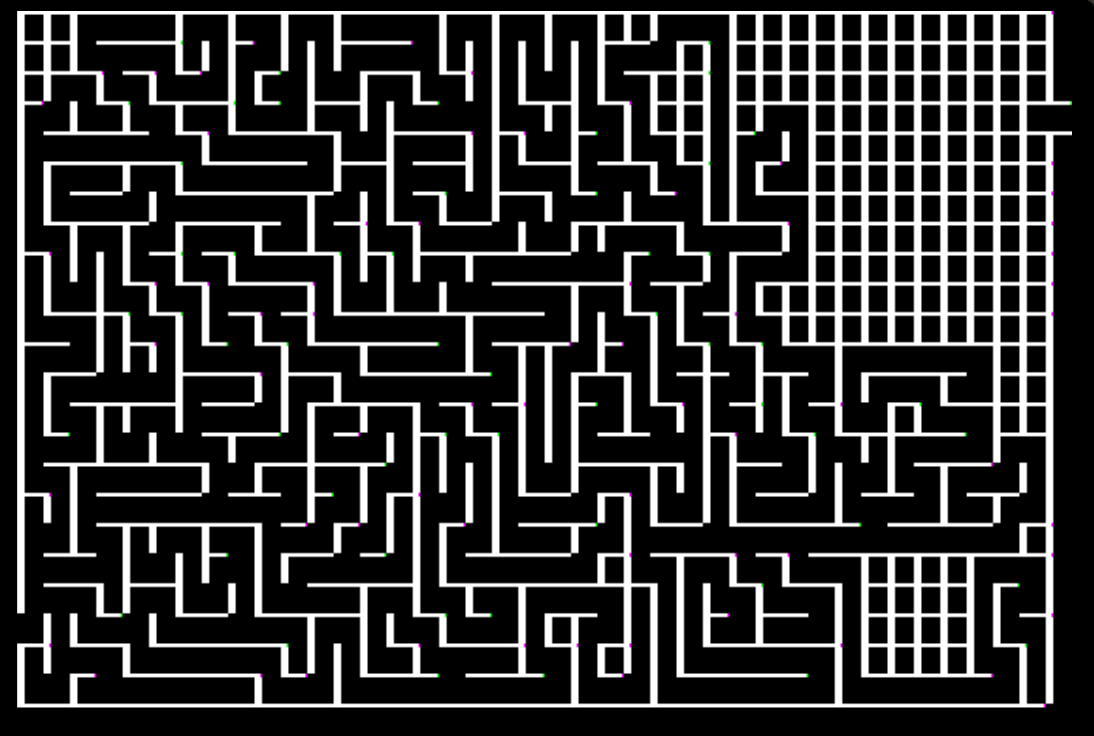
Unlike a normal maze where you can study the whole layout, Maze Runner hides the corridors ahead of you. As you explore, the maze is uncovered, letting you build a mental map (and occasionally realize you’ve been confidently wrong for several turns).
Winning
Reach the exit and the game celebrates your victory, then your move count becomes the measure of glory. If you’re chasing high scores, the real game is learning to solve the maze cleanly, not just eventually.
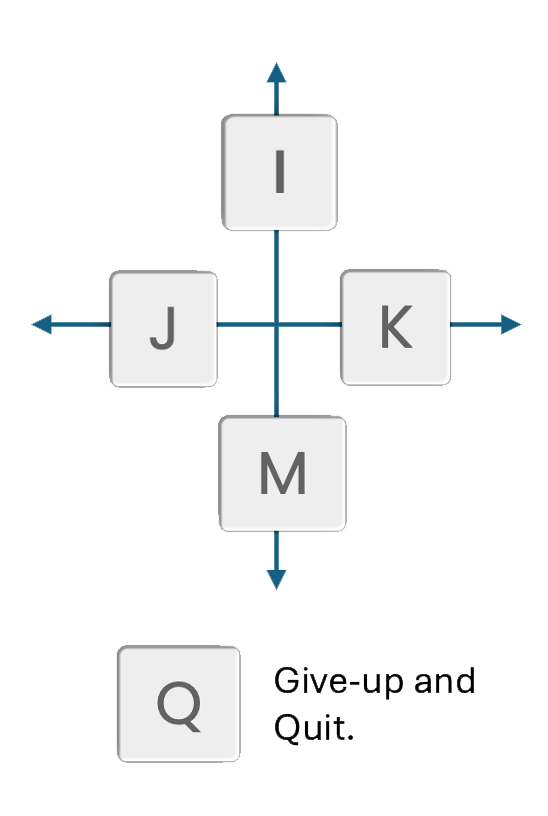
The arrow keys will work as well
on an Apple //e or better.

If you want to replay a particular maze, you must first quit the game and have the seed number (could be negative or positive) of the maze you wish to replay. You can quit the game at the instruction screen, during the game, and at the maze puzzle conclusion. When you quit, you will be sent to the command line that has “/MAZE/:”.
Entering “V” in addition to the seed_number will replay the maze, however the whole maze is revealed, not hidden.
Press Return
Entering just the seed_number, without “V”, will replay the maze in original game format, with the maze hidden.

→
Press Return
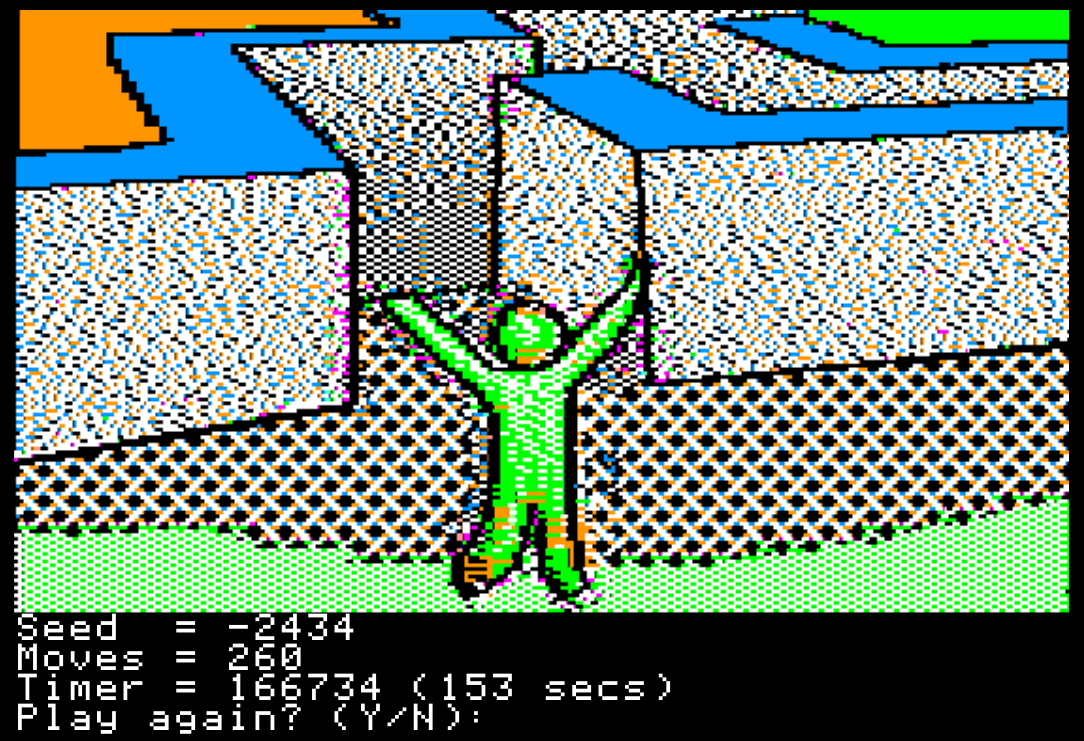
Replaying a maze
Win or lose, you will be prompted (Re)Play again? (R/Y/N).
Make note of the “Seed” number (see below).
Pressing “R” will replay the existing maze.
Pressing “Y” will generate a new maze
Pressing “N” will dump you out to a /MAZE/: prompt.
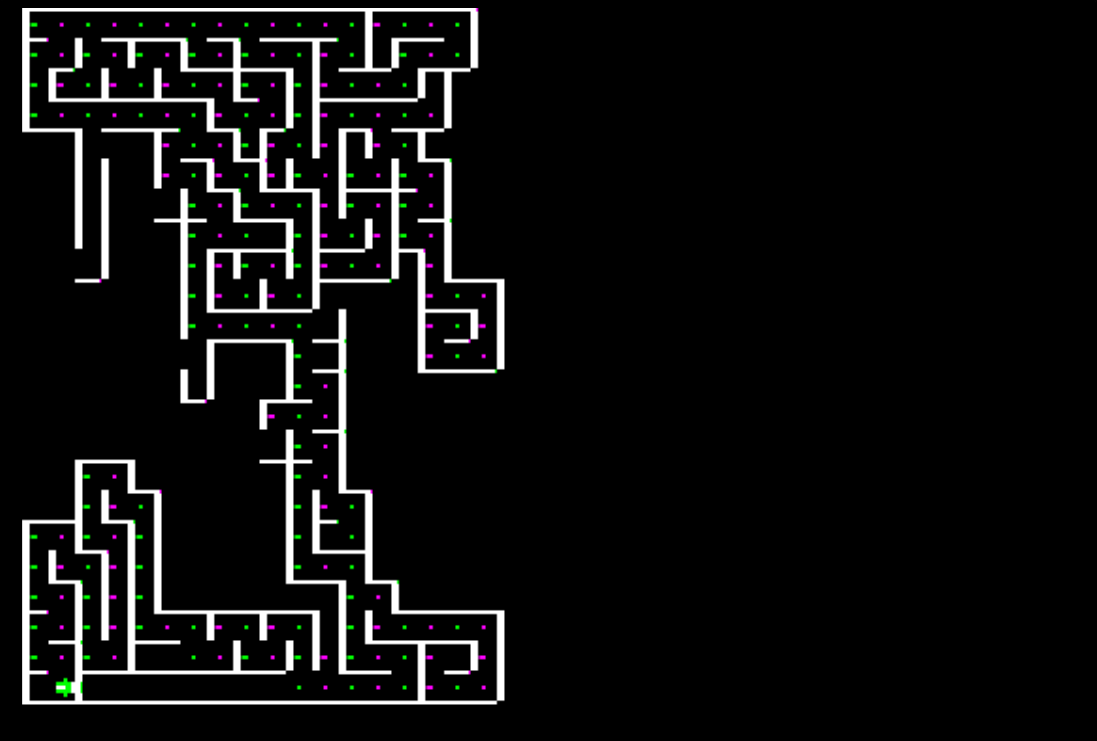
→


Technical Specifications
Apple ][+ computer or better.
64k of memory or better
5-1/4” Floppy Disk Drive connected to a floppy disk drive controller.
Optional: Joystick (if you wish to play with a joystick)
Apple ][+ computer or better.
64k of memory or better
5-1/4” Floppy Disk Drive connected to a floppy disk drive controller.
On an Apple ][+, you must use the I, J, K, M keys, as there are no up-down arrow keys.
Apple ][+ computer or better.
64k of memory or better
5-1/4” Floppy Disk Drive connected to a floppy disk drive controller.